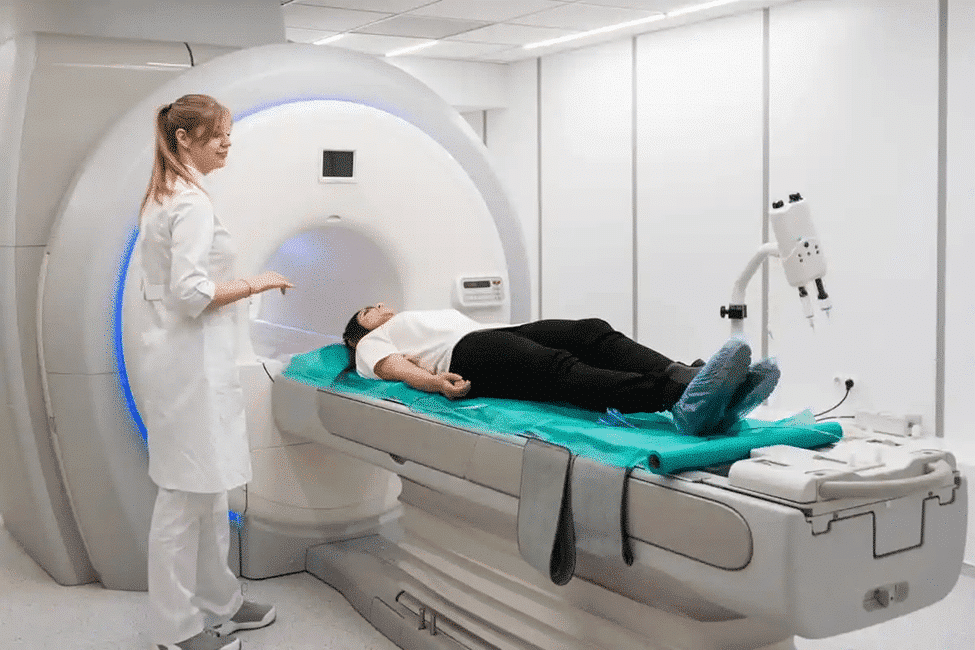
Course Overview
This comprehensive 8-week foundation course provides healthcare professionals with essential knowledge and practical skills in magnetic resonance imaging. Whether you're new to MRI or looking to strengthen your foundational understanding, this program offers thorough coverage of MRI physics, safety considerations, and basic scanning techniques.
You'll develop a deep understanding of how MRI technology works, learn to implement proper safety protocols to protect patients and staff, and gain hands-on experience with fundamental scanning sequences. Our expert instructors bring years of clinical experience to ensure you receive practical, real-world knowledge that you can immediately apply in your practice.
What You'll Learn
MRI Physics Fundamentals
Understand the principles of nuclear magnetic resonance, signal generation, and image formation in MRI systems.
Comprehensive Safety Protocols
Master MRI safety zones, screening procedures, and emergency response protocols for patient and staff protection.
Basic Scanning Sequences
Learn to operate fundamental MRI pulse sequences including T1, T2, FLAIR, and gradient echo imaging.
Image Quality Optimization
Develop skills in parameter selection and troubleshooting to achieve optimal image quality in clinical scans.
Course Syllabus
Introduction to MRI Physics
Basic principles of magnetism, nuclear magnetic resonance, and the fundamentals of signal generation in MRI systems.
MRI Safety and Screening
Comprehensive safety protocols, patient screening procedures, implant compatibility, and MRI safety zones.
Image Formation and Contrast
Understanding T1, T2 relaxation times, proton density, and how tissue characteristics affect image contrast.
Basic Pulse Sequences
Spin echo, gradient echo, inversion recovery sequences, and their clinical applications in routine imaging.
Image Quality Parameters
Signal-to-noise ratio, spatial resolution, scan time optimization, and artifact recognition and correction.
Anatomical Imaging Protocols
Standard protocols for brain, spine, musculoskeletal, and body imaging with proper patient positioning.
Contrast Agent Administration
Gadolinium-based contrast agents, injection protocols, adverse reactions, and nephrogenic systemic fibrosis prevention.
Practical Hands-On Training
Supervised scanner operation, patient setup, protocol selection, and quality control procedures.